
Trusted Rug Repair and Fringe Restoration NYC: 2026 Guide for Murray Hill Residents
Most people who bring us a damaged rug have already tried to ignore the problem for six months. That is not a criticism it is just what we see. A client from Murray Hill dropped off a hand-knotted Afghan wool rug last spring that had been sitting rolled in a closet on East 37th Street since a move two years earlier. The fringe on one end was almost entirely gone, a corner had unraveled back about three inches into the pile, and a previous repair attempt with fabric glue had stiffened the foundation in a way that made honest restoration significantly harder. The rug was still savable, but the path was longer than it needed to be.
Here is the contrarian take we offer every new customer: the damage itself is rarely the biggest problem. The bigger problem is choosing the wrong person to fix it. Rug repair and fringe restoration NYC is a legitimate specialty, and in a city with thousands of cleaning and textile businesses, the gap between a skilled restorer and someone who will make things worse is enormous. This post walks through the real diagnostic process behind the most common damage patterns we see, and what to look for when you are deciding who to trust with the work.
What “Fringe Damage” Actually Means and Why It Is More Serious Than It Looks
Fringe is not decorative trim sewn onto the edge of a rug. On a hand-knotted rug, fringe is the exposed continuation of the warp threads the structural skeleton that every knot in the pile is tied around. When fringe wears away, breaks, or gets cut off incorrectly, the foundation of the rug begins to unravel from the end inward. We have picked up rugs in Gramercy and Kips Bay where what looked like a fringe problem had already migrated two to four inches into the body of the rug because the owner assumed it was cosmetic.
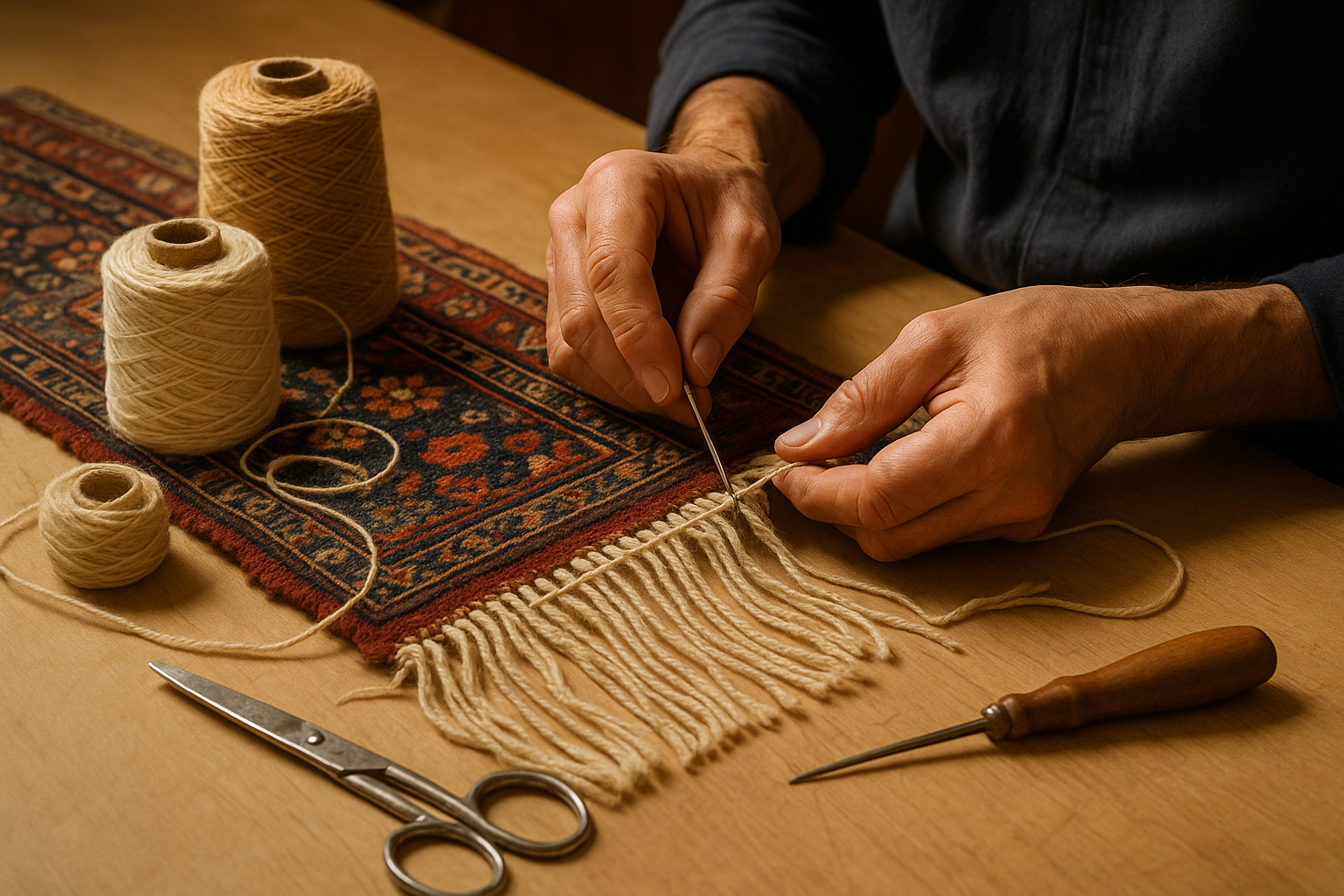
The diagnostic question we ask first is whether the warp threads are intact below the fringe loss. If they are, a skilled restorer can secure the end with a hand-sewn overcast stitch and reattach or regraft fringe that matches the original fiber content and weight. If the warp threads themselves have broken, the repair requires reweaving a slower, more involved process that should be done under magnification by someone trained in hand-knotted construction. We are always honest about which situation a rug is in before any work begins.
Four Damage Problems We Diagnose Regularly, and How They Get Fixed
Unraveling Edges and Side Cords
Symptoms: the rug’s side edge is fraying, the pile rows nearest the edge are loosening, or the wafting that holds rows together is visibly coming apart. Cause: foot traffic concentrated at the border, heavy furniture placed directly on the edge, or vacuum rollers pulling at the selvage. Professional fix: the damaged selvage is rewrapped with wool or cotton cord matching the original, and any loose pile rows are resecured before more knots migrate. Prevention note placing furniture legs on felt pads and keeping vacuum beater bars away from rug edges eliminates most selvage stress.
Moth Damage in the Pile
Symptoms: irregular bare patches, usually not at high-traffic areas, often on the underside or in a section that sat under furniture. Cause: wool-eating moth larvae, which thrive in undisturbed, low-light conditions — exactly the situation in many Murray Hill apartments where rugs live under heavy sofas for years. Professional fix: the rug is first treated to eliminate any active infestation, then the bare foundation is rewoven with matching wool pile. Color matching is the hardest part; a restorer with dye experience is essential here. According to the American Lung Association, rugs can harbor biological material including insect matter and allergens that standard vacuuming does not fully remove, which is why professional cleaning should accompany any moth repair.
Pet Damage — Chewed Corners and Urine Foundation Rot
Symptoms: a chewed or torn corner, sometimes with backing exposed, or a section of rug that feels stiff and brittle underfoot with a persistent odor. Cause: corner chewing is straightforward mechanical damage; the stiff-and-brittle problem is more serious and indicates that urine has broken down the fiber structure of the foundation over time. Professional fix: chewed corners can be reknot-woven if there is enough structural material to anchor into. Foundation rot from urine saturation is a different problem sections of foundation may need to be cut out and rewoven from scratch. This is a case where a restorer needs to probe the foundation honestly and tell you whether the repair cost justifies the rug’s value. We have had that conversation with clients in Tribeca and the Upper East Side, and we will always give you a straight answer.
Wear Channels and Pile Loss on High-Traffic Paths
Symptoms: a visibly flattened or thinned strip running across the rug, usually corresponding to a doorway or hallway path. Cause: cumulative abrasion compressing or breaking pile fibers at the base. Professional fix: if pile is compressed but the foundation is intact, deep cleaning and pile grooming can partially restore loft. If pile fibers have broken at the root, reweaving is required. The IICRC’s S100 Standard for Professional Cleaning of Textile Floor Coverings notes that proper cleaning technique is critical for wool and natural-fiber rugs to avoid accelerating existing wear aggressive scrubbing on a thinning pile area by an untrained cleaner can convert a maintenance problem into a restoration problem fast.
Red Flags When Choosing a Rug Repair Contractor in NYC
This is where we want to be genuinely useful rather than self-promotional, because the wrong contractor is a real risk in this market. Here is what we tell customers to watch for.
Any business that quotes a fringe restoration price by the linear foot over the phone, without seeing the rug, does not understand the work. Fringe pricing depends on the warp thread condition, the fiber type, whether reweaving is needed at the foundation, and the correct fringe material to source. A phone quote is a guess at best.
Ask directly whether the technician doing the repair has hand-knotted rug construction experience or training consistent with IICRC standards. The Institute of Inspection, Cleaning and Restoration Certification maintains professional standards for textile restoration; a shop that cannot reference any formal training framework should be pressed on their actual credentials.
Watch out for shops that subcontract repair work without disclosing it. In New York, it is common for cleaning businesses to accept rugs and ship them to a third party for repairs. That is not always wrong, but you deserve to know who is actually touching your rug and where it is going. We do our cleaning in-plant and are transparent about every step of the process.
Finally, ask to see examples of completed fringe restoration or reweaving work on rugs of similar construction to yours. A restorer who does this work regularly will have photos or will be comfortable letting you inspect finished pieces. Vague answers here are a signal to keep looking.
What Murray Hill Conditions Do to Rugs Over Time
Murray Hill is a dense, walkable neighborhood the foot traffic in most apartments reflects that. Rugs on East 34th through East 40th Streets see year-round urban particulate from street and subway sources, and the pre-war and postwar building stock in the area often means concrete subfloors, radiator heat that dries fiber, and limited ventilation that traps humidity in summer. The Rug and Home industry estimates that hand-knotted Oriental and Persian rugs can last 100 years or more with proper care, but improper cleaning and delayed repairs are among the leading causes of premature fiber breakdown. A rug that gets professional attention on a reasonable cycle the IICRC recommends every 12 to 18 months depending on traffic and household conditions is a rug that rarely needs major structural restoration.
Frequently Asked Questions
How do I know if my rug’s fringe can be restored or needs to be replaced entirely?
The answer depends on the condition of the warp threads beneath the fringe. If the warps are intact, a skilled restorer can secure the foundation and reattach or regraft matching fringe material. If the warp threads have broken or if unraveling has migrated into the body of the rug, structural reweaving is required before any fringe work can hold. We assess this in person before quoting any work there is no reliable way to determine this from a photo alone.
What does rug repair and fringe restoration typically cost in NYC in 2026?
Fringe restoration in the New York City market generally runs between $8 and $18 per linear foot for a standard hand-knotted rug, depending on fiber type, foundation condition, and the sourcing requirements for matching material. Structural reweaving for corner or edge damage is priced by the square inch of affected area and can range from $25 to $75 or more per square inch for complex hand-knotted work. We provide written estimates after a physical inspection so there are no surprises.
Can I drop off my rug at Eastside Rug Cleaning from Murray Hill, or do you offer pickup?
We offer both. Many Murray Hill clients schedule a pickup directly from their apartment we serve the neighborhood regularly and can coordinate a time that works with building access requirements. If you prefer to bring the rug to us, contact us to arrange drop-off. Either way, the rug receives the same in-person assessment and written repair estimate before any work begins.
Restore Your Rug Before the Damage Spreads
Don’t wait for loose fringe, unraveling edges, moth damage, or worn areas to become a larger restoration problem. A professional assessment can determine whether your rug needs simple fringe repair, reweaving, or another restoration approach.
Eastside Rug Cleaning serves customers throughout Murray Hill, Manhattan, Brooklyn, Queens, and surrounding New York City neighborhoods. Contact our team to arrange a pickup or inspection. We’ll examine your rug in person, explain what needs to be repaired, and provide a written estimate before any work begins.
Call Eastside Rug Cleaning or visit eastsiderugcleaning.com to schedule your rug repair or fringe restoration today.
Related from East Side Rug Cleaning: Rug Color Restoration Manhattan · Skilled Team Backs Cleaning for Fine Rugs in the Upper East Side · Same Day Rug Cleaning on the Upper East Side