
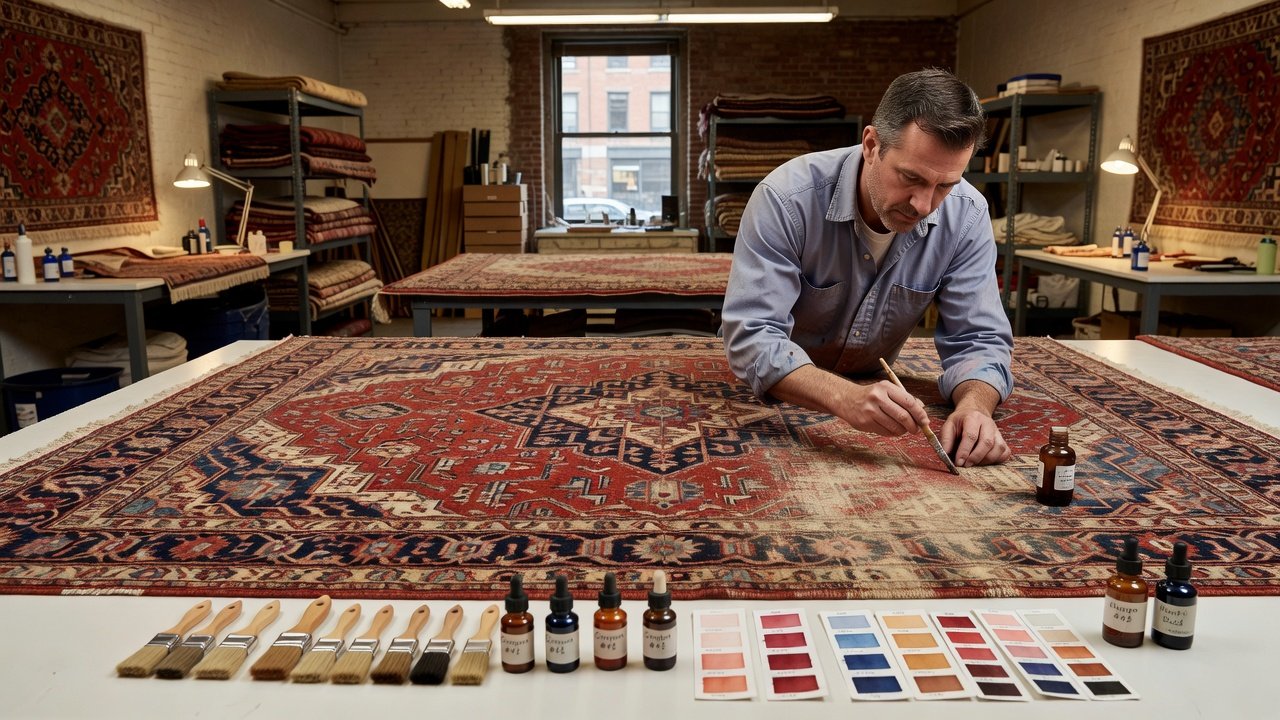
Honest Rug Color Restoration Manhattan: 2026 Guide for Williamsburg Residents
What does it actually cost to bring a faded, stained, or sun-bleached rug back to life in New York City — and how do you know whether a rug is even worth restoring? Those are the two questions we hear most often from clients who find us after discovering their cherished rug has lost the color that made it worth owning in the first place. Rug color restoration in Manhattan and across Brooklyn neighborhoods like Williamsburg is not a flat-rate service. The price varies widely depending on what caused the color loss, the fiber type, the dye method, and how far the damage has gone. We want to give you a straight answer about all of it.
We’ve cleaned and restored rugs from Bedford Avenue lofts, Park Slope brownstones, Upper East Side prewar apartments, and Tribeca gallery spaces. In our experience, color problems are among the most misunderstood issues a rug owner faces. Some clients assume the color is gone permanently. Others assume a quick dye job will fix anything. The reality is more nuanced, and getting the diagnosis right before any work begins is what separates a good outcome from a ruined rug.
What Color Damage Actually Looks Like and Why It Happens
Color loss rarely looks the same from one rug to the next. A faded medallion on a hand-knotted Persian is a different problem than a pink wine stain on a wool kilim or a bleached streak on a vintage Moroccan. Before we quote any rug color restoration work, our team does a full fiber and dye assessment, because the cause determines the fix and the cost.
Here are the six color problems we diagnose most frequently, along with what’s actually driving each one and what professional correction involves.
Sun Fade Along One Side or Corner
Symptom: One half of the rug is noticeably lighter, often following the path of a south- or west-facing window. The rest of the rug still has good depth of color. We see this constantly in Williamsburg, where converted warehouse lofts and floor-to-ceiling windows are a design staple and where direct afternoon sun can pour across the same twelve square feet for four or five hours a day.
Cause: Ultraviolet exposure breaks down the chromophores in natural dyes and many synthetic ones. Wool is particularly vulnerable because its protein structure doesn’t resist UV the way nylon does.
Professional fix: Partial re-dyeing using fiber-reactive or acid dyes matched to the original color, followed by mordant-fixing to lock the new dye into the fiber. This requires hand-application, not immersion the surrounding undamaged area needs to be protected throughout. Cost for partial re-dyeing on a 6×9 rug typically runs $280–$480 in the current NYC market, depending on the complexity of the pattern match.
Can it be prevented? Rotating the rug 180 degrees every six months and using UV-filtering window film widely available at hardware stores along Metropolitan Avenue significantly slows fade progression.
Bleach Damage or Harsh Chemical Spots
Symptom: A white or cream-colored patch, often with a sharp, irregular border. The pile isn’t destroyed, but the color is completely stripped in that zone.
Cause: Bleach, alkaline cleaners, or improper spot treatments. We’ve seen this from well-meaning tenants in Murray Hill and Astoria who grabbed a bathroom spray and applied it to a wine stain without realizing wool fibers react to high-pH chemicals the way skin reacts to a chemical burn.
Professional fix: Spot re-dyeing is possible when the fiber itself is intact. Our technicians use a spectrophotometer-aided color match process to blend the repair zone. If the fiber has been structurally damaged brittle, breaking, or matted re-dyeing alone won’t restore the look, and reweaving the damaged section may be necessary before any color work begins. Bleach spot repair ranges from $150 for a small, isolated area to $600 or more if the damage is extensive or the pattern is complex.
Can it be prevented? Yes — never apply any household cleaner to a wool or silk rug without confirming it’s pH-neutral. Call us first; we give free phone consultations on spot emergencies.
Dye Bleeding After Water or DIY Cleaning
Symptom: Colors that have run into adjacent areas, creating muddy borders around design elements. Red and burgundy dyes are the worst offenders, and they tend to migrate into cream or ivory fields.
Cause: Many hand-knotted rugs particularly older Afghan, Pakistani, and some Turkish pieces — use dyes that are not fully colorfast. According to the IICRC’s S100 Standard for Professional Cleaning of Textile Floor Coverings, wool and natural-fiber rugs should be immersion-washed only with controlled pH levels and temperature to prevent exactly this kind of dye migration. A home steam cleaner or a rental carpet machine doesn’t maintain those controls.
Professional fix: If the bleeding is caught early, a controlled re-wash with dye-setting agents can arrest further migration and reduce the halo effect. If the dye has fully set in the wrong place, corrective re-dyeing of the affected field is required. This is painstaking work. Expect $350–$700 depending on how much of the rug is affected and whether the original colors can be reliably matched.
Can it be prevented? Have any pre-owned or antique rug dye-tested before its first professional cleaning. We do this as part of our standard intake process.
Overall Dulling and Graying From Soil Accumulation
Symptom: The whole rug looks flat, grayish, and lifeless — but the colors haven’t actually changed. This is especially common in high-traffic Williamsburg apartments where outdoor particulates, cooking residue, and foot traffic grind fine soil deep into the pile.
Cause: Soil particles act as an abrasive at the fiber level and also create a visual scrim over the original color. The American Lung Association notes that rugs and carpets can trap allergens, dust mites, pet dander, and mold spores, making regular deep cleaning especially important — but that trapped material also physically masks color vibrancy.
Professional fix: This is the good-news diagnosis. Deep immersion washing — agitation, controlled extraction, and proper flat drying — restores most of the original color without any re-dyeing at all. Cost for a standard immersion wash and full dry on a 9×12 rug runs $275–$425 at our facility in 2026. No color correction work needed.
Can it be prevented? The IICRC recommends professional cleaning every 12–18 months for rugs in active households. In a dense urban environment like New York City, we’d push toward the 12-month end of that range.
Fringe Yellowing or Darkening
Symptom: White or ivory fringe has gone yellow, gray, or brown. The rug body looks fine; just the fringe reads dirty or aged.
Cause: Cotton fringe absorbs soil faster than pile because it lies flat on the floor surface. In prewar buildings common across the Upper West Side and parts of Williamsburg near the waterfront — older flooring can leach wood stain or adhesive residue into the fringe over time.
Professional fix: Fringe whitening uses enzyme-based pre-treatment followed by hand-washing. If the fringe is too far gone structurally, replacement fringe can be hand-sewn and matched to the original. Fringe restoration runs $75–$200 for a standard-length rug perimeter.
Patchy Color From Improper Previous Repairs
Symptom: A section of the rug looks noticeably different — wrong shade, different texture in the pile, or a visible seam. Someone tried to fix it before.
Cause: Amateur re-dyeing or previous repair work that didn’t account for dye lot differences, fiber differences between old and new wool, or sheen variation between hand-spun and machine-spun yarn.
Professional fix: Correcting prior poor work is the most variable cost category we have. Sometimes we can re-dye over an amateur repair. Sometimes we need to remove the old repair and start from the fiber up. Get a full assessment before committing to any price. We’ve seen previous “repairs” from online tutorials that took us three times longer to correct than the original problem would have required.
What Drives the Price Up and What Keeps It Reasonable
The Rug and Home industry estimates that hand-knotted Oriental and Persian rugs can last 100 years or more with proper care, but improper cleaning is among the top causes of premature fiber damage. Color restoration is similar: done right, it extends a rug’s life significantly and preserves its value. Done carelessly, it destroys both.
Price is driven by four things: the size of the affected area, the complexity of the pattern requiring color matching, the fiber type (silk costs more to work with than wool; cotton is easier), and whether re-dyeing is partial or full. A small bleach spot on a solid wool rug is an afternoon’s work. A full re-dyeing of a 10×14 hand-knotted Persian with a twenty-color medallion design is a week-long project involving multiple skilled technicians.
What keeps cost reasonable is catching problems early. A dye bleed addressed within two weeks of the incident is far cheaper to correct than one that’s been set for two years. If something looks wrong with your rug’s color, call before the next cleaning cycle makes it permanent.
Frequently Asked Questions
How much does rug color restoration cost in Manhattan or Williamsburg?
It depends on the problem and the rug. Spot repair for a bleach stain or small bleed area typically runs $150–$480. Partial re-dyeing for sun fade on a mid-size rug runs $280–$600. Full-rug color correction or re-dyeing on a large hand-knotted piece can reach $800 or more. We provide a written estimate after a physical assessment — we don’t quote prices without seeing the rug first.
Can all faded or stained rugs be restored to their original color?
Not always. If sun fade has degraded the fiber itself — not just stripped the dye — the restored color may not hold evenly. If a previous DIY repair used incompatible materials, the correction is more complex. We give honest assessments. If a rug isn’t a good candidate for color restoration, we’ll tell you clearly and explain why, so you’re not spending money on work that won’t hold.
Is rug color restoration the same as rug dyeing, and is it safe for antique rugs?
Color restoration is a targeted process — correcting specific areas of loss or damage while protecting surrounding color. Full re-dyeing changes the entire rug’s palette. For antique rugs, we approach color work conservatively: dye-testing, fiber analysis, and minimal intervention unless necessary. Many antique rugs from clients in Tribeca and the Upper East Side have natural color variation from age that’s part of their character, and we’re careful not to erase that in the process of making repairs.
If your rug’s color isn’t what it used to be — whether it’s a hand-knotted Persian in a Williamsburg loft, a vintage kilim in Park Slope, or an heirloom runner from a Murray Hill apartment — we’d like to take a look at it. Our team at Eastside Rug Cleaning has worked through every color problem described above, and we give straight answers about what’s fixable, what it costs, and what to expect. Reach out to schedule a pickup or drop-off assessment — no obligation, no pressure.
Related from East Side Rug Cleaning: Rug Color Restoration Manhattan · Skilled Team Backs Cleaning in Upper East Side, Manhattan · Trusted Rug Repair and Fringe Restoration NYC
Our services
Skilled Team Backs Cleaning in Upper West Side, Manhattan · High Traffic Rug Cleaning for Upper East Side Homes and B… · Skilled Team Backs Cleaning in Upper East Side, Manhattan · Skilled Team Backs Cleaning Upper East Side, Manhattan · Skilled Team Backs Cleaning in Upper East Side, Manhattan · Skilled Team Backs Cleaning Upper East Side, Manhattan