
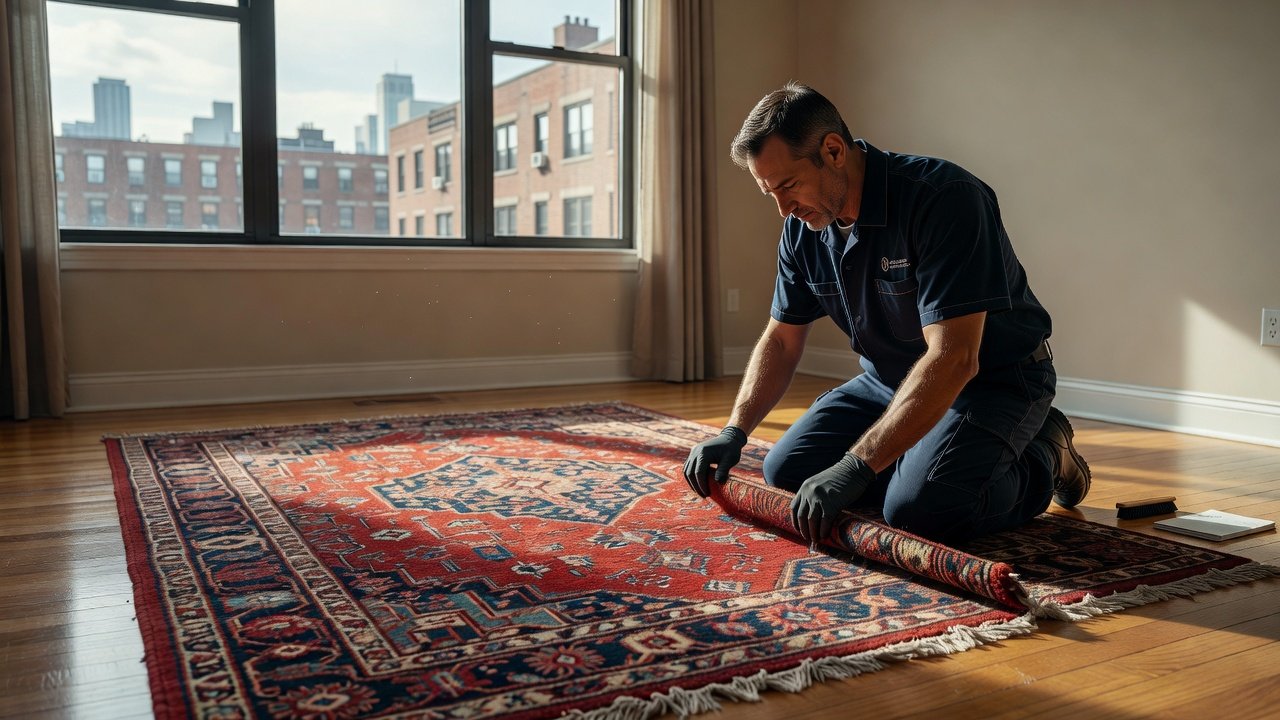
Honest Professional Rug Cleaning Upper East Side NYC: 2026 Guide for Astoria, Queens Residents
Before you rent a steam cleaner from the hardware store on Steinway Street or pour club soda on that wool kilim, here is a quick check. Can you vacuum without a beater bar? Yes, safe to do yourself. Can you blot a fresh spill with cold water and a clean cloth? Also, yes. Can you submerge a hand-knotted Persian in your bathtub and hang it over the shower rod to dry in your Astoria apartment? That one gets expensive fast. This post is about drawing that line clearly, because we have spent years picking up rugs from homes across Queens, the Upper East Side, Tribeca, and Park Slope, and most of the damage we see was caused by well-intentioned homeowners who just needed better information.
Professional rug cleaning Upper East Side NYC is a phrase we hear from clients all over the city, including many in Astoria and Long Island City who trust us to handle their most valuable floor pieces. The work we do at Eastside Rug Cleaning is not magic it is the right water temperature, the right pH, the right drying environment, and two decades of knowing what happens when those variables are wrong. Some of that work genuinely does not require us. Some of it absolutely does.
What You Can Safely Handle at Home
Regular maintenance is something any careful homeowner can do, and doing it well actually extends the time between professional cleanings.
Vacuuming on a low-suction setting, with the beater bar turned off or raised, removes dry surface soil before it works down into the pile. For most Astoria apartments where subway particulates and street dust come in through windows and on shoes vacuuming twice a week on a high-traffic rug is not overkill. Flip the rug occasionally and vacuum the back too. Loose dirt falls out of the foundation that way.
Rotating your rug every six months matters more than most people realize. Foot traffic and UV exposure from west-facing windows are uneven forces. A quarter-turn prevents one section from wearing or fading faster than the rest. This costs nothing and takes two minutes.
Fresh spills liquid that landed in the last few minutes respond well to blotting with a clean white cloth and cold water. Work from the outside edge of the spill toward the center. Do not scrub. Do not use hot water. If the fiber is wool, heat causes shrinkage and color migration immediately. For pet accidents on synthetic rugs, an enzymatic cleaner applied according to label directions is reasonable. On wool, silk, or any hand-knotted construction, skip the enzymatic product and call us instead.
Airing a rug out on a clean surface, if you have access to a roof deck or a building’s back courtyard, can reduce odor between cleanings. Most New York City apartments do not offer this option, but some Astoria houses and attached homes do. Fifteen minutes of airflow on each side does help.
Where DIY Stops and Real Damage Begins
The honest answer is that most of the risk lives in three areas: moisture, chemistry, and mechanical force. Get any one of those wrong on a natural-fiber rug and the repair cost dwarfs whatever you saved by skipping a professional cleaning.
Wet cleaning at home is the most common source of serious damage we see. A client in Astoria last spring brought us a 6×9 hand-knotted Afghan rug she had washed in the bathtub after a cooking oil spill. She used dish soap, rinsed it as well as she could, and leaned it against the bathroom wall to dry. Four days later it smelled like a basement and the foundation had begun to rot. The rug was not unsalvageable, but the restoration cost more than three professional cleanings would have. The problem was not effort — she worked hard on it. The problem was drying time. The American Lung Association notes that mold growth begins within 24 to 48 hours on wet organic materials, and a wool rug folded against a wall in a humid bathroom is exactly that kind of environment.
Rental extraction machines present a similar issue. The machines available at hardware stores are designed for synthetic wall-to-wall carpet. They inject water at pressures and volumes that are appropriate for that substrate. On a hand-knotted rug with a cotton warp and wool pile, the same machine can over-wet the foundation, cause the rug to shrink asymmetrically, and drive soil deeper rather than extracting it. The IICRC’s S100 Standard for Professional Cleaning of Textile Floor Coverings specifically recommends immersion washing or controlled hot-water extraction by trained technicians for wool and natural-fiber rugs to prevent shrinkage and color bleeding not because professionals want your business, but because the physics of fiber behavior require it.
Chemistry is the third hazard. Alkaline cleaners including many all-purpose sprays under the kitchen sink strip the lanolin from wool and cause dye instability. Acid-based cleaners can do similar damage to silk. The pH range that is safe for most natural-fiber rugs is narrow, and identifying it requires either testing or experience. We see rugs from Park Slope and the Upper West Side regularly where a single application of the wrong product has permanently altered the dye in a way no cleaning can reverse.
The Real Reasons to Call a Professional
It is not about being overly cautious. It is about specific conditions where the tools, training, and environment genuinely cannot be replicated at home.
Deep soil extraction requires controlled immersion or truck-mounted extraction equipment with enough vacuum power to remove water fully. Our facility can dry a rug in a controlled environment within 24 hours. A New York City apartment cannot. According to the Institute of Inspection, Cleaning and Restoration Certification (IICRC), area rugs should be professionally cleaned every 12 to 18 months depending on foot traffic and household conditions a cycle that reflects how quickly urban environments load rugs with particulate soil that surface vacuuming cannot remove.
Antique rugs, silk rugs, and rugs with visible dye bleeding or prior repairs need professional assessment before any liquid touches them. The Rug and Home industry estimates that hand-knotted Oriental and Persian rugs can last over 100 years with proper cleaning and storage, but improper DIY cleaning is among the top causes of premature fiber damage. A 19th-century Tabriz from a Tribeca townhouse and a machine-made polypropylene from a Murray Hill studio do not respond to the same process. Treating them the same way is the mistake.
Pet urine that has dried and set requires a submersion wash to fully remove the uric acid crystals from the foundation. Topical treatment masks odor temporarily but does not eliminate the source. We see this frequently with clients across Queens and upper Manhattan who have tried three or four products before calling us at which point the rug has been over-wetted multiple times and the odor has penetrated the warp threads.
A Practical Decision Framework
Use this to guide your judgment before you reach for a product or a rental machine.
Safe to do yourself: routine vacuuming with the beater bar off, blotting fresh liquid spills with cold water and a clean cloth, rotating the rug seasonally, airing it in a clean low-humidity space if available, and using a dry rug powder on synthetic rugs for light odor between cleanings.
Call a professional for: full wet washing of any natural-fiber or hand-knotted rug, pet urine that has dried or soaked through to the backing, any visible dye bleeding or color instability, antique or silk rugs, rugs that smell musty after getting wet, rugs with prior repairs or fringe work, and any rug you genuinely cannot afford to damage.
The line between those two lists is not arbitrary. It follows the physical limits of drying time, chemistry safety, and what the equipment can actually do.
Why Astoria Residents Send Rugs to Us
Astoria is one of the denser residential neighborhoods in Queens, with a mix of pre-war six-story buildings, attached row houses, and newer condos near the waterfront. Apartments are small. Outdoor drying space is rare. Humidity in summer is high enough that a damp rug can develop mildew in under two days. Those conditions make professional cleaning more necessary here than in a suburban home with a backyard and a garage.
We pick up and deliver throughout Astoria, and many of our Queens clients also need work done on rugs that lived in previous apartments on the Upper East Side or are heading there when they move. Professional rug cleaning Upper East Side NYC and in Astoria really is one continuous service for us the same standards, the same facility, the same team regardless of which borough the rug comes from.
Frequently Asked Questions
How often should Astoria residents schedule professional rug cleaning?
For most households in Astoria with moderate foot traffic, once every 12 to 18 months is appropriate for natural-fiber and hand-knotted rugs. Homes with pets, young children, or allergy sufferers should lean toward the shorter end of that range. New York City’s urban dust load subway particulates, street soil, and seasonal humidity accelerate buildup compared to suburban environments, so waiting longer than 18 months typically means the rug needs more intensive work when it does come in.
Can I use a rental carpet cleaner on my wool or Persian rug?
We strongly advise against it. Rental extraction machines are calibrated for synthetic wall-to-wall carpet, not hand-knotted or natural-fiber rugs. They inject more water than these rugs can dry safely in an apartment setting, which creates conditions for mold, shrinkage, and dye bleeding. The IICRC recommends controlled immersion or professional hot-water extraction by trained technicians specifically because of how differently wool and cotton foundations respond to moisture and mechanical agitation.
What is the difference between professional rug cleaning on the Upper East Side and what Astoria residents need?
The cleaning process itself is identical we use the same facility, the same wash methods, and the same drying conditions for every rug regardless of where it comes from. The practical difference is pickup and delivery logistics. We serve both neighborhoods with regular routes, so Astoria residents do not need to transport rugs to Manhattan. The needs of the rugs are the same: proper pH, full soil extraction, controlled drying, and a pre-inspection to catch any condition issues before the wash begins.
If you are in Astoria, Long Island City, the Upper East Side, or anywhere across Queens and upper Manhattan and you are not sure whether your rug needs professional attention or just better home maintenance, call us. We are happy to look at photos, talk through what you are dealing with, and give you an honest answer — even if that answer is that you can handle it yourself for now. Reach out to Eastside Rug Cleaning at eastsiderugcleaning.com to schedule a pickup or get a free estimate. We have been doing this long enough to tell you the truth about what your rug actually needs.
Related from East Side Rug Cleaning: Team Our Cleaning · Rug Cleaning City · Skilled Team Backs Cleaning for Fine Rugs in the Upper East Side