
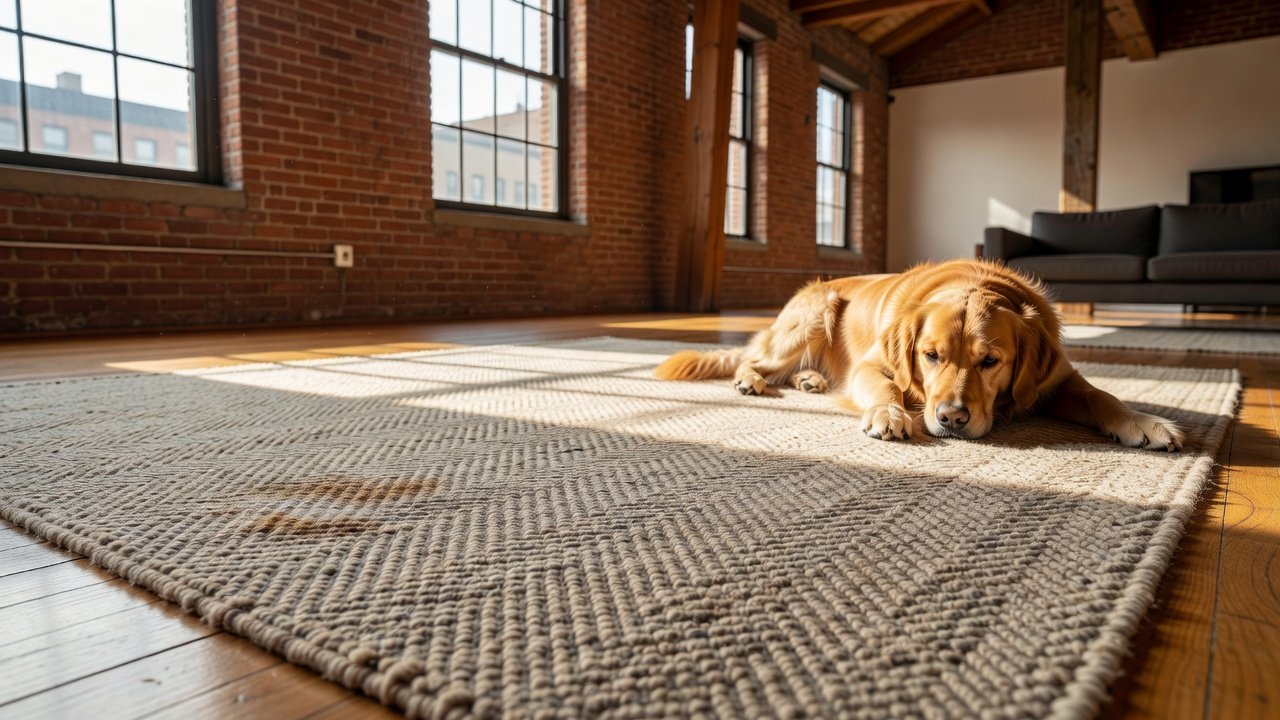
Honest Pet Odor Removal from Rugs New York: 2026 Guide for Williamsburg, Brooklyn Residents
Does your Williamsburg apartment smell fine when you first walk in, then hit you with something sour after ten minutes? That delayed reaction is one of the most common things we hear from clients, and it almost always traces back to the rug. Pet odor removal from rugs in New York is something our team at Eastside Rug Cleaning handles every week across Brooklyn, and the calls from Williamsburg particularly from the Bedford Avenue corridor and the North Side lofts have been climbing steadily as more residents adopt dogs and cats in smaller, less-ventilated spaces.
The problem with pet urine in rugs is that what you can smell on the surface is rarely the whole story. Urine wicks downward through pile, through the foundation weave, and into the backing. In a 600-square-foot Williamsburg apartment with no outdoor drying space and windows that face a brick wall, a rug never fully dries on its own after an accident and that trapped moisture becomes a compounding problem. This guide is built around the specific, observable signs that tell you the situation has crossed from “keep an eye on it” into “call a professional now.”
We’ll also walk you through what the actual cleaning job involves, because honest expectations matter. This isn’t a process you can replicate at home with an enzyme spray and a fan.
Warning Signs Your Rug Needs Professional Pet Odor Removal Now
Not every pet accident requires an emergency call. But several do. Here is how to read what your rug is telling you.
The smell returns within 48 hours of cleaning it yourself
You’ve blotted, you’ve used a store enzyme spray, maybe you’ve even rented a carpet cleaner. The odor fades for a day, then comes back sometimes stronger when the weather is humid. This happens because surface treatments cannot reach urine salts that have crystallized deep in the rug foundation. When humidity rises (and in a Williamsburg apartment in July, it always does), those salts reactivate and off-gas again. Call a pro now.
You can pinpoint a specific zone on the rug that always smells worse
If one corner or one strip along the edge consistently smells stronger than the rest, that zone has likely absorbed multiple incidents over time. Layered urine deposits bond to wool or cotton fibers at a molecular level. A single cleaning cycle will not undo years of repeated saturation. Call a pro now.
The rug backing feels stiff or crunchy in spots
Run your hand along the underside of the rug. Healthy cotton or jute backing has some flexibility. If you feel rigid, almost cardboard-like patches, that stiffness is dried urine residue that has bonded into the foundation. This also signals potential latex or adhesive breakdown if the rug has a manufactured backing. Call a pro now.
You see yellow or rust-colored staining on the pile that wasn’t from food or wine
Urine oxidizes over time and shifts from a faint stain to a yellow or amber discoloration, particularly on lighter wool and silk-blend rugs. We see this frequently on hand-knotted pieces from clients in Park Slope and Tribeca who assumed the discoloration was sun fading. It wasn’t. Oxidized urine staining requires targeted treatment before general washing skip that step and the stain can set permanently during the wash process. Call a pro now.
Your pet keeps returning to the same spot, even after you’ve cleaned it
Cats especially, but dogs too, will re-mark any area where residual odor remains — odor they can detect well below the threshold of human smell. If your pet is treating one rug zone as a bathroom despite your efforts, the rug still smells like a bathroom to them. Call a pro now.
The odor is strongest close to the floor, not when you’re standing
Get down to floor level. If the smell intensifies significantly compared to when you were standing, the source is in the rug or subfloor, not the air. This low-concentration odor pocket is exactly what the American Lung Association warns about when discussing how rugs trap allergens, dust mites, and biological waste close to the breathing zone of children and pets who spend time on the floor.
Call a pro now.
You notice the smell only in humid weather or after rain
This is the reactivation pattern. Urine salts are hygroscopic — they pull moisture from the air. On a rainy Tuesday in Brooklyn, those salts absorb ambient humidity and begin off-gassing ammonia and mercaptans again. If the odor tracks with the weather, the contamination is deep. Call a pro now.
The rug has been in place for more than a year with a pet in the home and has never been professionally cleaned
According to the Institute of Inspection, Cleaning and Restoration Certification (IICRC), area rugs should be professionally cleaned every 12 to 18 months depending on foot traffic and household conditions and that baseline assumes no pets. With a dog or cat, accumulation happens faster. Even without visible accidents, dander, oils, and micro-deposits build up. Keep an eye on it and book a cleaning proactively before you have a problem you can smell.
What the Job Actually Involves: Setting Honest Expectations
A customer from the Northside of Williamsburg brought us a 5×8 hand-tufted wool rug last spring. She had a rescue greyhound who had apparently been using one corner as a secondary bathroom for the better part of two years. She had tried three different enzyme products and a professional carpet cleaning company that cleaned the rug in-place. The smell never left.
Here is what we did, and what any legitimate pet odor removal job on a natural-fiber rug actually requires.
First, we inspect the rug under UV light before it’s touched by water. UV reveals the full extent of urine deposits — often much larger than the visible stain suggests. We document this for the client so there are no surprises about what we found versus what they reported.
Next, the rug goes through a dry soil removal process a thorough dusting that dislodges particulates from the foundation before any moisture is introduced. This step is frequently skipped by operators who clean rugs on-site or in-home, and skipping it means you’re washing soil deeper into the rug rather than removing it.
The IICRC’s S100 Standard for Professional Cleaning of Textile Floor Coverings recommends immersion washing for wool and natural-fiber rugs to avoid shrinkage and color bleeding and immersion is also the only method that allows full-depth flushing of urine contamination. We submerge and flush the rug in temperature-controlled water with appropriate cleaning solutions matched to the fiber type. For heavily contaminated rugs, we apply a pre-soak treatment specifically formulated to break the bond between urine salts and fiber proteins before the main wash.
After washing, controlled drying in a climate-managed environment is non-negotiable. In a Williamsburg apartment with a bathroom-sized floor plan and no airflow, a wet rug is a mold risk. We dry flat, with consistent airflow, monitoring moisture levels until the foundation not just the pile reads dry. That process typically takes 24 to 48 hours depending on rug density.
Finally, a post-cleaning UV inspection confirms the result. We’ve had cases mostly severe, long-term saturation where one wash cycle isn’t sufficient, and a second treatment is needed. We tell clients this upfront rather than returning a rug that still has a problem.
For that Williamsburg greyhound rug, two treatment cycles over five days completely resolved the odor. The client confirmed it with a follow-up a month later, including reporting that her dog had stopped returning to the corner.
Why Williamsburg Apartments Make This Harder Than It Looks
We work across all five boroughs and into neighborhoods like Astoria, Murray Hill, and Forest Hills, and every building type presents its own constraints. Williamsburg lofts and converted industrial spaces tend to have concrete subfloors, which means urine that reaches the subfloor can penetrate and create a secondary odor source the rug alone cannot fix. Pre-war rentals on the South Side often have poor ventilation, which slows drying and accelerates mold growth in contaminated rugs.
None of this is a reason to give up on a rug even a heavily saturated one. The Rug and Home industry estimates that hand-knotted Oriental and Persian rugs can last 100 years or more with proper care, but improper or incomplete cleaning is among the top causes of premature fiber damage. We’d rather restore a rug correctly than see a client discard something irreplaceable because a previous cleaning attempt made the problem worse.
Frequently Asked Questions
How long does pet odor removal from rugs take in New York?
For most rugs we pick up from Williamsburg and surrounding Brooklyn neighborhoods, the full process inspection, dusting, washing, and drying takes three to five business days. Severely contaminated rugs requiring a second treatment cycle may take up to seven days. We offer pickup and delivery throughout Brooklyn, so you’re not without your rug any longer than necessary.
Can pet odor be fully removed from a wool or hand-knotted rug, or is the damage permanent?
In the majority of cases, yes odor can be fully eliminated with proper immersion washing and targeted pre-treatment. The exception is when urine has been present for years and has caused dye migration or significant fiber degradation. We assess this during our UV inspection before cleaning begins and give clients an honest prognosis upfront, including any risk of color change or texture shift.
Is it worth cleaning a rug professionally if my pet is still having accidents?
Yes, with one important addition: after we return a clean rug, we recommend a waterproof rug pad underneath and, in active-accident situations, a washable rug protector on top until the pet is fully trained or the behavior is addressed. A clean rug also removes the scent signal that draws pets back to the same spot, which often reduces repeat accidents significantly. If accidents are ongoing, we can advise on a cleaning schedule that protects the rug long-term.
Schedule Your Williamsburg Rug Cleaning
If you recognize two or more of the warning signs above, the rug is not going to improve on its own and the longer urine contamination sits, the more difficult and expensive the remediation becomes. Our team at Eastside Rug Cleaning picks up from Williamsburg, Park Slope, Astoria, Tribeca, and across New York City. We’ll inspect your rug honestly, tell you exactly what we find, and return it clean or tell you upfront if the damage is beyond what cleaning can fix. Reach out to schedule a pickup; there’s no obligation until we’ve assessed the rug in our facility and confirmed what the job actually requires.
Related from East Side Rug Cleaning: Skilled Team Backs Cleaning for Fine Rugs in the Upper East Side · Team Our Cleaning · Honest Professional Rug Cleaning Upper East Side NYC