
Trustworthy Custom Rug Cleaning Gramercy Park Manhattan: 2026 Guide for Upper West Side Residents
A neighbor from the Upper West Side called us last spring with a story we hear often. She had a hand-knotted Heriz rug about 8 by 10 feet, wool pile, deep burgundy field that had been in her family for thirty years. She’d trusted a company that showed up with a carpet-cleaning van, sprayed something on it, vacuumed it up, and left. Six weeks later the pile was stiff, the reds had bled into the ivory border, and the foundation was still damp enough to smell. The company had no trace online beyond a single listing. She found us while searching for custom rug cleaning Gramercy Park Manhattan and asked if we could reverse the damage. Some of it we could. Some of it the dye bleed was permanent.
We tell that story not to alarm you, but because it’s an honest account of what happens when a rug owner picks the wrong operator. In a city where storage is tight, apartments run humid, and a good rug can represent thousands of dollars, the choice of who cleans it matters more than most people realize. This guide is written as practical buyer advice the kind a knowledgeable neighbor would give you over coffee. We’ll cover what credentials actually mean, the questions worth asking before you book, and the warning signs that should send you elsewhere.
Why “Custom” Cleaning Is Not Just a Marketing Word
Rugs are not carpet. A machine-made synthetic rug from a big-box retailer and a hand-knotted silk Isfahan require completely different water temperatures, dwell times, agitation methods, and drying conditions. “Custom” rug cleaning means the process is matched to the specific fiber, dye type, construction, and condition of your rug not run through a one-size-fits-all machine cycle.
The IICRC’s S100 Standard for Professional Cleaning of Textile Floor Coverings recommends professional hot-water extraction or immersion washing for wool and natural-fiber rugs specifically to avoid shrinkage and color bleeding two outcomes that happen when cleaners skip the fiber-assessment step. Any company worth hiring will inspect your rug before quoting you, not after.
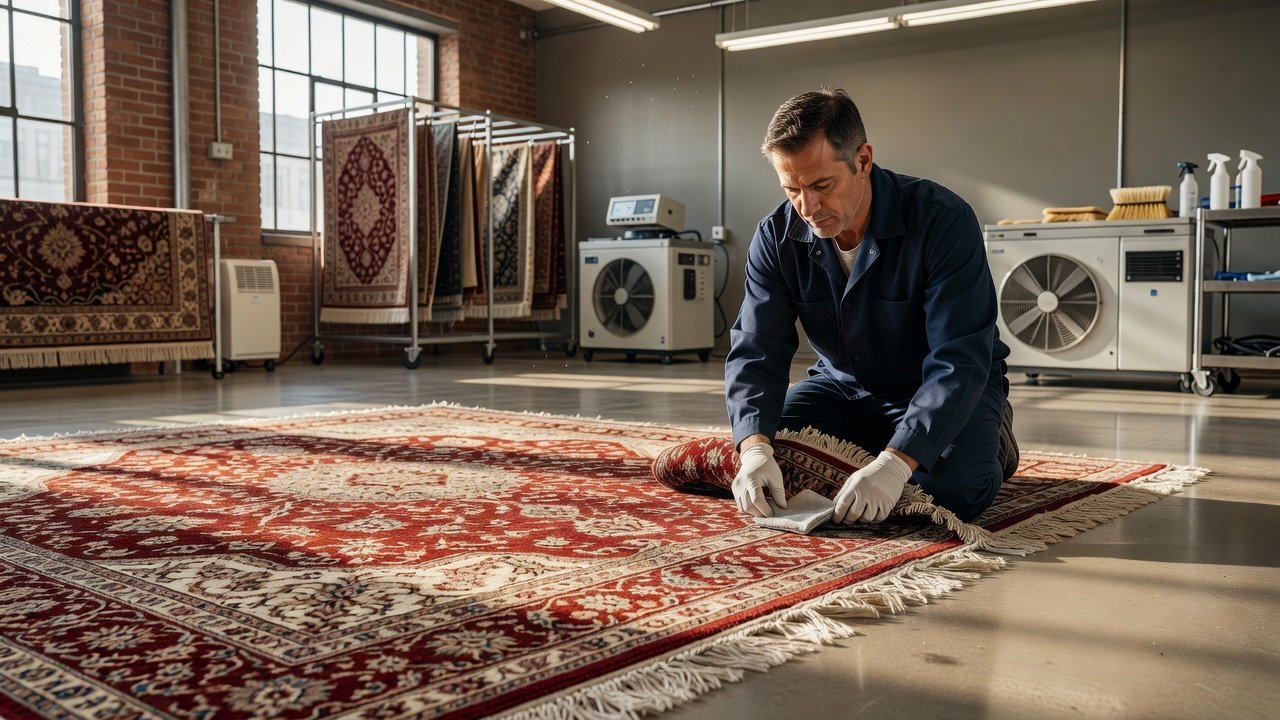
In practice, custom cleaning for a Gramercy Park client might mean full immersion washing in a temperature-controlled bath, hand-finishing the fringe, and two-stage drying in a climate-managed space. For a sisal rug in a Tribeca loft, it means almost no water at all. The process follows the rug. If a company can’t articulate how they’ll approach your specific piece, that’s a problem.
Credentials That Actually Mean Something
The cleaning industry has a lot of self-issued certifications that mean very little. A few actually matter.
The Institute of Inspection, Cleaning and Restoration Certification the IICRC is the gold standard. Look for technicians who hold the WRT (Water Restoration Technician) and, more specifically, the CCT (Carpet Cleaning Technician) or the newer RCT (Rug Cleaning Technician) designation. These require coursework, written exams, and continuing education. Ask the company directly: “Which of your technicians hold current IICRC certification, and in what category?” A vague answer is a red flag.
Beyond certifications, ask whether the company carries general liability insurance and workers’ compensation coverage. In New York State, both are required for legitimate operators. If a cleaner damages your rug and carries no insurance, your recourse is a small-claims filing not a replacement check. Request proof of insurance before anyone touches your rug.
Membership in the Association of Rug Care Specialists (ARCS) is a secondary indicator of seriousness. It’s not universal, but companies that invest in industry associations tend to stay current on best practices. It’s a reasonable data point, not a dealbreaker either way.
Questions to Ask Before You Book
The conversation before the appointment tells you almost everything. Here are the questions we think every rug owner should ask.
First: where will my rug be cleaned? Many companies pick up rugs and send them to a central facility which is fine, but you should know where that is and whether it’s climate-controlled. Rugs cleaned in humid, poorly ventilated facilities take longer to dry and are at higher risk for mold growth. The American Lung Association notes that rugs can trap allergens, dust mites, and mold spores, making proper drying conditions critical for households with allergy or asthma concerns.
Second: how do you test for dye stability before washing? Any reputable operator will do a spot test in an inconspicuous area before full immersion. If they say they don’t need to because they’ve done it a thousand times, walk away.
Third: what’s the drying process, and how long does it take? Rugs should be dried flat or hung in a controlled environment, never returned to a client damp. For NYC apartments where opening windows in January isn’t an option and humidity in July runs high a company without a proper drying room is operating recklessly.
Fourth: do you have before-and-after documentation? Reputable companies photograph rugs before cleaning to document pre-existing damage. This protects both parties.
Fifth: what’s your pricing structure, and what’s included? Get the full scope in writing pickup, delivery, cleaning, fringe work, moth treatment if applicable. An unusually low base price often excludes things you’ll end up paying for anyway.
Sixth: can you provide references from clients with similar rugs? A company that regularly handles antique Persians should have clients who own antique Persians, not just wall-to-wall carpet jobs from office buildings in Murray Hill.
Seventh: what happens if something goes wrong? This is the question most people skip. Ask about their damage claims process before you need it.
Red Flags That Should Give You Pause
We’ve heard enough cautionary tales from clients in Park Slope, Astoria, and across the Upper West Side to have a clear picture of what bad operators look like before the damage is done.
No physical address. If a company lists only a phone number and a service area with no verifiable location for their facility, there’s no accountability. Where exactly is your rug while it’s in their care?
Pricing by the square foot with no inspection. Legitimate custom rug cleaning requires seeing the rug first. Fiber type, pile height, soil level, and any pre-existing damage all affect the price and the method. A company that quotes you $1.50 per square foot over the phone without knowing what you have is not offering custom service.
Pressure to decide immediately. High-pressure booking tactics “this price is only good today” are a consistent marker of companies that rely on impulse, not reputation.
No evidence of prior work. In 2026, every legitimate cleaning company has a web presence, reviews on Google or Yelp, and some form of portfolio or client feedback. A brand-new listing with no history and five-star reviews from accounts with no other activity is a pattern worth noticing.
Offering to clean the rug in your home. For area rugs especially wool, silk, or natural fiber in-home cleaning is almost never appropriate. There’s no way to properly flush soil from the foundation, no controlled drying environment, and excess moisture can damage wood floors and subfloors. Some companies offer it because the equipment cost is lower, not because it’s better for your rug.
How to Compare Quotes Without Getting Misled
Quotes for custom rug cleaning in Manhattan can range widely from around $4 per square foot on the lower end to $12 or more for antique or silk pieces requiring delicate hand-washing. Neither number is automatically right or wrong without context.
When comparing quotes, ask each company to itemize: base cleaning, pickup and delivery, any specialty treatments (deodorizing, moth protection, fringe restoration), and estimated turnaround time. A $6-per-square-foot quote that includes free pickup, delivery, and a 5-day turnaround may be a better value than a $4 quote that tacks on fees for each of those items.
Turnaround time is worth paying attention to. Most reputable facilities in the New York area return rugs within 7 to 14 days. Faster isn’t always better rushed drying is a shortcut that can trap moisture. Longer than three weeks for a standard cleaning job may indicate the facility is understaffed or overwhelmed.
The Rug and Home industry estimates that hand-knotted Oriental and Persian rugs can last over 100 years with proper cleaning and storage, but improper DIY cleaning is among the top causes of premature fiber damage. The cost of a single professional cleaning done right is a fraction of what it would cost to repair or replace a rug that was cleaned wrong.
What Eastside Rug Cleaning Does Differently
We serve clients across Manhattan and the boroughs from Gramercy Park townhouses to pre-war apartment buildings on the Upper West Side, from Williamsburg lofts to classic six-lines in Forest Hills. Every rug we take in receives a written inspection report before cleaning begins. We test dye stability, document pre-existing condition, and match the wash method to the specific piece. Our facility uses climate-controlled drying, and we don’t return a rug until it’s fully dry and re-inspected.
We’re not the only qualified company in New York. But we believe the process we’ve described in this guide is what responsible custom rug cleaning looks like and we think you deserve to hold any company, including us, to that standard.
Frequently Asked Questions
How often should I have my area rug professionally cleaned in a Manhattan apartment?
According to the IICRC, area rugs should be professionally cleaned every 12 to 18 months depending on foot traffic and household conditions. In Manhattan apartments where outdoor shoes are worn indoors, windows stay closed much of the year, and urban dust accumulates quickly we generally recommend cleaning every 12 months for rugs in high-traffic areas and every 18 months for those in bedrooms or low-use rooms. Households with pets or allergy sufferers may benefit from more frequent cleaning.
What does “custom rug cleaning” actually mean, and how is it different from standard carpet cleaning?
Custom rug cleaning means the cleaning method is tailored to your specific rug’s fiber content, dye type, construction, and condition rather than applying a single process to every piece. A wool Persian and a machine-made polypropylene rug require different water temperatures, agitation methods, and drying times. Standard carpet cleaning services treat rugs like wall-to-wall carpet, which can cause shrinkage, color bleeding, and foundation damage in delicate or natural-fiber pieces. Reputable custom cleaners inspect the rug before any work begins and explain their approach before you commit.
Is it safe to have my rug cleaned in my Gramercy Park or Upper West Side apartment, or does it need to go to a facility?
For most quality area rugs especially wool, silk, cotton, or natural-fiber pieces in-home cleaning is not recommended. It doesn’t allow for proper soil flushing, controlled drying, or accurate pre- and post-cleaning inspection. In-home cleaning also introduces excess moisture that can damage hardwood floors common in pre-war Manhattan buildings. Reputable companies pick up your rug, clean it at a dedicated facility with appropriate equipment, and return it fully dry, typically within 7 to 14 days.
Schedule Your Custom Rug Cleaning in Gramercy Park
If you have a rug that deserves careful, knowledgeable handling whether it’s a family heirloom from a Gramercy Park home or a contemporary flat-weave from a Williamsburg apartment we’d be glad to take a look. Contact Eastside Rug Cleaning at eastsiderugcleaning.com to schedule a pickup or ask questions before you commit. We’ll give you straight answers, a written assessment, and a process you can actually trust.
Related from East Side Rug Cleaning: Team Our Cleaning · Rug Cleaning City · Skilled Team Backs Cleaning in Upper East Side, Manhattan